OPK is the abbreviation for OEM Porting Kit, and its technology complies with the technical standard ITU-T J.104x(DRM)and "GY/T 277-2019 Technical Specification for Digital Copyright Management of Video and Audio Content Distribution" issued by the State Administration of Radio and Television.
OPK is a ChinaDRM adaptation development kit provided by Huanyu Trust (Beijing) Technology Co., Ltd. (DTA) for DRM solution providers, chip manufacturers, smart terminal manufacturers, and more. Chip manufacturers have completed the development of OPK's chip adaptation; Terminal manufacturers reuse the adaptation results of chip manufacturers, resulting in less adaptation workload.
The OPK architecture diagram is as follows
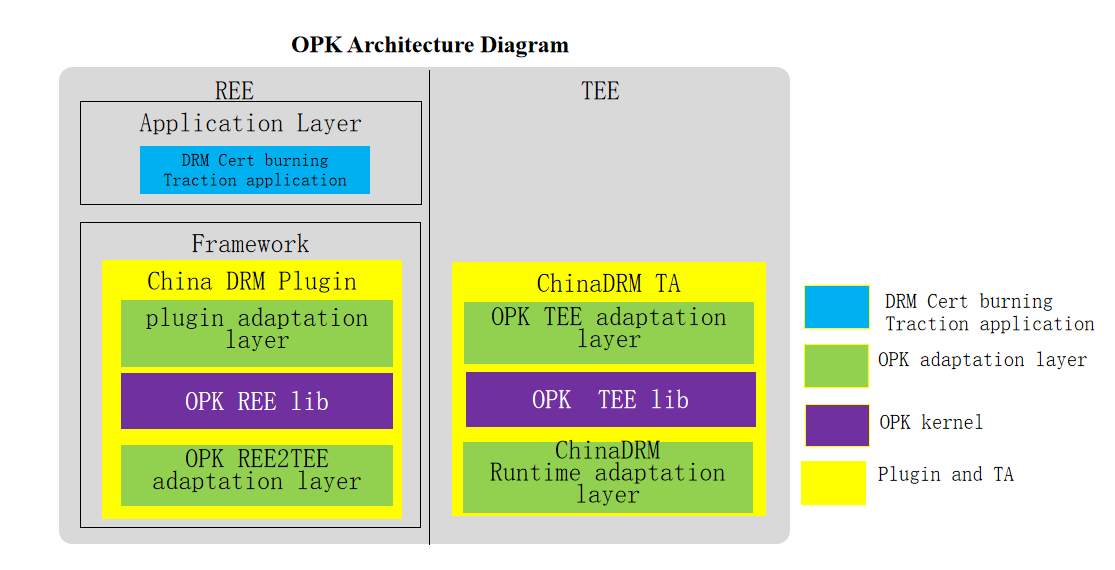
All example codes included in the adaptation layer need to be adapted according to the characteristics of the chip platform. The library or SDK provided by DTA needs to be obtained from DTA and is not related to the chip. Merge and compile adaptation layer code and libraries to obtain DRM plugins
The OPK function complies with standards, as well as technical documents such as DTA ChinaDRM FAQ.
² Content encryption: Supports AES CBC, CTR (fully encrypted and sample encrypted), SM4 CBC (fully encrypted and sample encrypted)
² Content format: Supports H264, H265, AVS3 encoding, supports TS, MP4, HLS, DASH and other encapsulation
² License: Supports online and offline licenses; Support license renewal mechanism; The supported video output protection rules include HDCP and ADCP
² Trust Chain: Supports DTA Trust Root and SM2 Certificate
² Certificate Provision: Supports pre setting the device model key using key burning method in the secure storage partition of the terminal, and placing DRM client keys and certificates under the protection of the device model key
² Application layer interface: Compliant with Android MediaDRM interface. Support obtaining DRM properties through the system api(such as MediaDRM.getProperty interface)
OPK has low requirements for usage conditions, and there are already many use cases of mainstream smart chip and terminal manufacturers at home and abroad
² Operating system requirements: Suitable for Android system versions 9 and above
² Authorization for the use of dependency libraries: Project dependencies are placed in the DTA pre built directory and are provided by DTA. Solution providers, chip and terminal manufacturers sign a Developer Agreement with Huanyu Trust to obtain authorization for library evaluation and trial, while terminal manufacturers sign an Authorization Use Agreement with Huanyu Trust to obtain commercial authorization
² Chip platform: Requires support for TEE, Secure Video Path, SM2, SM3, SM4, AES128 bit, RSA3072 bit, SHA256 algorithm; It is necessary to support unique device IDs and unique chip (chip model) ID.
Follow the steps below to complete the development of chip OPK adaptation and the compilation and deployment of terminal OPK
² Chip OPK adaptation development
Chip manufacturers select the corresponding version of the cdrmc_demo directory or cdrmc_demo directory based on the Android system version, as well as the adaptation layer example code in the cdrm_ta directory. Based on the example code, they complete the encoding of the DRM HW runtime interface and the adaptation encoding of the secure video path (SVP). Retrieve dependency libraries from DTA. After completing the testing according to the "Test Instructions", deliver the adaptation layer code to the terminal manufacturer
² Terminal OPK compilation
Terminal manufacturers obtain OPK adaptation layer code from chip manufacturers, dependency libraries from DTA, merge and compile to obtain DRM plugins, and deploy them after completing testing according to the "testing instructions".
² Terminal OPK deployment
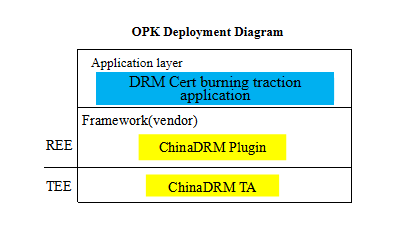
After the terminal completes the OPK adaptation work, the software installation and deployment form is shown in the following figure: 1) Place ChinaDRM Plugin and TA software into the terminal system DRM exclusive directory; 2) Place the DRM certificate into the traction application and deploy it to the designated directory of the system.
The OPK deployment diagram is as follows
² Terminal insertion of DRM certificate
The terminal inserts the device model key on the production line, and then inserts the DRM certificate under the protection of the traction application and model key.
After the manufacturer completes the adaptation work, they test the DRM function
Build DRM integrated testing environment
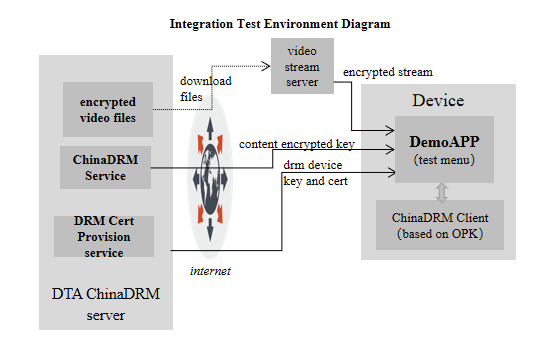
According to the "ChinaDRM Client Integration Test Environment User Manual", a test environment including stream services, DRM authorization services, and DemoAPP (including test piles) was set up. The OPK software test terminal was prepared for deployment, and DemoAPP was installed on the test terminal. The network connectivity stream services and DRM authorization services were also configured.
The schematic diagram of the integrated testing environment is as follows
² Certificate Placement Test
Run the DemoAPP on the testing terminal, select the "Certificate Placement" menu, click on "Execute Test", or run the traction application (bin file) on the testing terminal to perform the certificate DRM placement test. Please obtain the usage documentation for the traction application from DTA.
² Play and password stream test
Run DemoAPP on the testing terminal, select the stream playback menu, and click to execute playback.
Dozens of chips from leading SOC vendors for major smart terminals (TVs, set‑top boxes, mobile terminals, vehicle‑mounted terminals, etc.) have completed OPK adaptation and development, ChinaDRM capability release, as well as terminal‑side integration, deployment and application.
To get more about OPK or seek cooperation, please contact DTA by company email. DTA mailbox:service@trustdta.com.
OPK is the abbreviation for OEM Porting Kit, and its technology complies with the technical standard ITU-T J.104x(DRM)and "GY/T 277-2019 Technical Specification for Digital Copyright Management of Video and Audio Content Distribution" issued by the State Administration of Radio and Television.
OPK is a ChinaDRM adaptation development kit provided by Huanyu Trust (Beijing) Technology Co., Ltd. (DTA) for DRM solution providers, chip manufacturers, smart terminal manufacturers, and more. Chip manufacturers have completed the development of OPK's chip adaptation; Terminal manufacturers reuse the adaptation results of chip manufacturers, resulting in less adaptation workload.
The OPK architecture diagram is as follows
All example codes included in the adaptation layer need to be adapted according to the characteristics of the chip platform. The library or SDK provided by DTA needs to be obtained from DTA and is not related to the chip. Merge and compile adaptation layer code and libraries to obtain DRM plugins
The OPK function complies with standards, as well as technical documents such as DTA ChinaDRM FAQ.
² Content encryption: Supports AES CBC, CTR (fully encrypted and sample encrypted), SM4 CBC (fully encrypted and sample encrypted)
² Content format: Supports H264, H265, AVS3 encoding, supports TS, MP4, HLS, DASH and other encapsulation
² License: Supports online and offline licenses; Support license renewal mechanism; The supported video output protection rules include HDCP and ADCP
² Trust Chain: Supports DTA Trust Root and SM2 Certificate
² Certificate Provision: Supports pre setting the device model key using key burning method in the secure storage partition of the terminal, and placing DRM client keys and certificates under the protection of the device model key
² Application layer interface: Compliant with Android MediaDRM interface. Support obtaining DRM properties through the system api(such as MediaDRM.getProperty interface)
OPK has low requirements for usage conditions, and there are already many use cases of mainstream smart chip and terminal manufacturers at home and abroad
² Operating system requirements: Suitable for Android system versions 9 and above
² Authorization for the use of dependency libraries: Project dependencies are placed in the DTA pre built directory and are provided by DTA. Solution providers, chip and terminal manufacturers sign a Developer Agreement with Huanyu Trust to obtain authorization for library evaluation and trial, while terminal manufacturers sign an Authorization Use Agreement with Huanyu Trust to obtain commercial authorization
² Chip platform: Requires support for TEE, Secure Video Path, SM2, SM3, SM4, AES128 bit, RSA3072 bit, SHA256 algorithm; It is necessary to support unique device IDs and unique chip (chip model) ID.
Follow the steps below to complete the development of chip OPK adaptation and the compilation and deployment of terminal OPK
² Chip OPK adaptation development
Chip manufacturers select the corresponding version of the cdrmc_demo directory or cdrmc_demo directory based on the Android system version, as well as the adaptation layer example code in the cdrm_ta directory. Based on the example code, they complete the encoding of the DRM HW runtime interface and the adaptation encoding of the secure video path (SVP). Retrieve dependency libraries from DTA. After completing the testing according to the "Test Instructions", deliver the adaptation layer code to the terminal manufacturer
² Terminal OPK compilation
Terminal manufacturers obtain OPK adaptation layer code from chip manufacturers, dependency libraries from DTA, merge and compile to obtain DRM plugins, and deploy them after completing testing according to the "testing instructions".
² Terminal OPK deployment
After the terminal completes the OPK adaptation work, the software installation and deployment form is shown in the following figure: 1) Place ChinaDRM Plugin and TA software into the terminal system DRM exclusive directory; 2) Place the DRM certificate into the traction application and deploy it to the designated directory of the system.
The OPK deployment diagram is as follows
² Terminal insertion of DRM certificate
The terminal inserts the device model key on the production line, and then inserts the DRM certificate under the protection of the traction application and model key.
After the manufacturer completes the adaptation work, they test the DRM function
Build DRM integrated testing environment
According to the "ChinaDRM Client Integration Test Environment User Manual", a test environment including stream services, DRM authorization services, and DemoAPP (including test piles) was set up. The OPK software test terminal was prepared for deployment, and DemoAPP was installed on the test terminal. The network connectivity stream services and DRM authorization services were also configured.
The schematic diagram of the integrated testing environment is as follows
² Certificate Placement Test
Run the DemoAPP on the testing terminal, select the "Certificate Placement" menu, click on "Execute Test", or run the traction application (bin file) on the testing terminal to perform the certificate DRM placement test. Please obtain the usage documentation for the traction application from DTA.
² Play and password stream test
Run DemoAPP on the testing terminal, select the stream playback menu, and click to execute playback.
Dozens of chips from leading SOC vendors for major smart terminals (TVs, set‑top boxes, mobile terminals, vehicle‑mounted terminals, etc.) have completed OPK adaptation and development, ChinaDRM capability release, as well as terminal‑side integration, deployment and application.
To get more about OPK or seek cooperation, please contact DTA by company email. DTA mailbox:service@trustdta.com.